The Baldrus Fair Games Laboratory
Test the rules. Change the game.
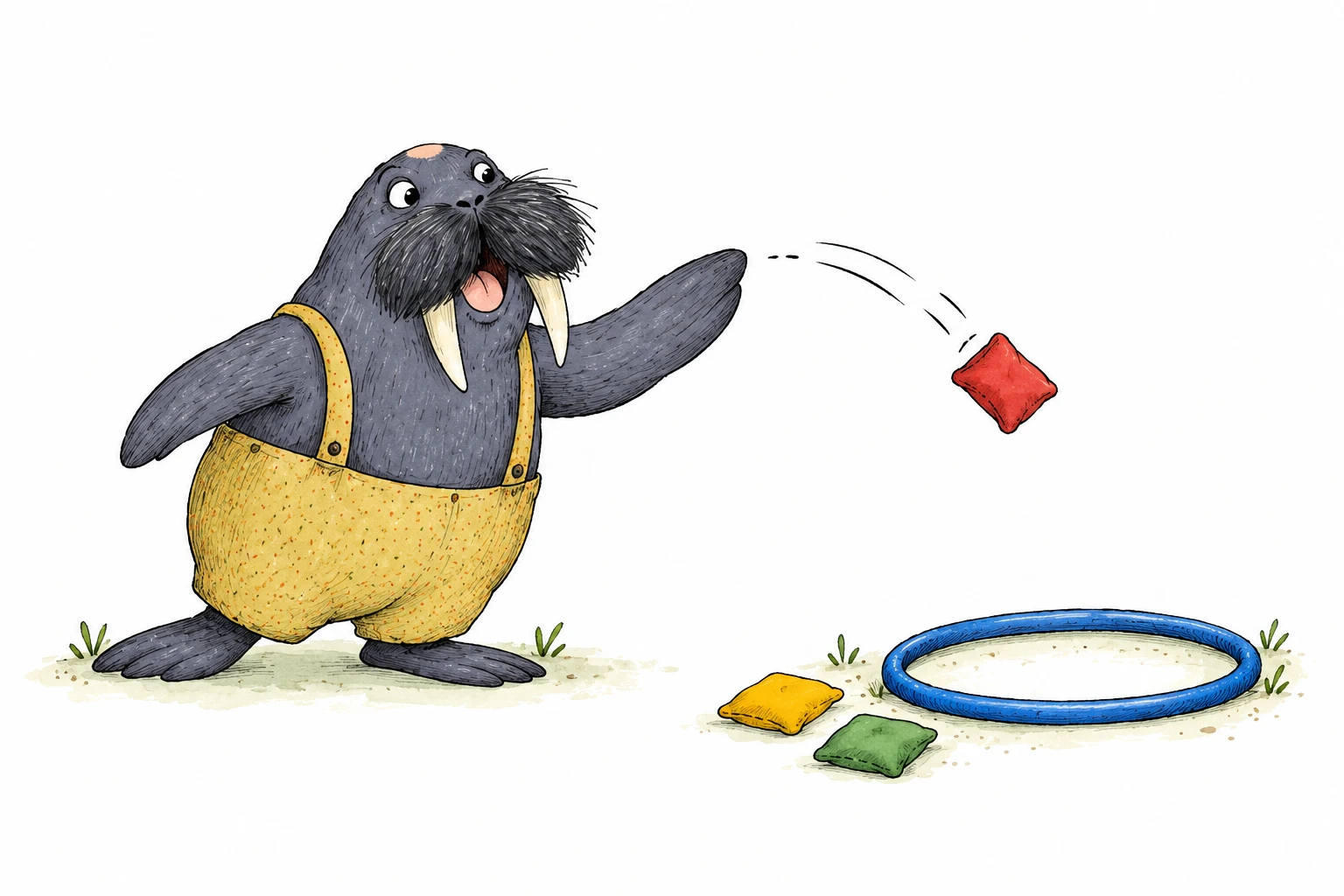
Fairness, competition and personal improvement
Investigate a suspiciously uneven game, rewrite its rules and test what makes play fair and welcoming.
Children will practise
- Explain an unfair rule using an example from a game or story.
- Agree and write rules someone else can follow.
- Record results and reflect on improvement and encouragement.
Make and keep: A tested fair-game instruction sheet for a class games booklet.
KS1: PE; English instructions and discussion; Mathematics; PSHE. Adapt the suggested connections to your setting.
How the session works
- 0–8 min · Meet the rule makers
Read page 5 and the story summary. The Baldrus choose events that suit them, then complain when other creatures win. Ask: ‘Does being good at a game make its rules fair?’
- 8–15 min · Test an uneven game
Choose one card from page 6. For example, team A throws from one metre and team B from three metres, with three throws each. Record hits without a leaderboard. Ask pupils what they noticed. Stop after this short demonstration.
- 15–23 min · Explain the problem
Use ‘This rule favours… because…’. Distinguish the rule from the result: losing once does not prove unfairness. Let pupils point to a card or use the story as evidence.
- 23–38 min · Redesign and retest
Use page 7 to agree throws, scoring, positions and access. Keep one chosen change clear. Rotate roles and test the new version. Use page 8 to record what changed and what was observed; small results help discussion but do not prove a general rule.
- 38–48 min · Compete with yourself
Each willing pupil has two rounds of three attempts using the same agreed setup. Record hits out of three. Notice one thing they tried differently. Improvement can be control, confidence or taking a turn, even if the score stays the same.
- 48–60 min · Publish and reflect
Groups complete page 9. Another group reads the instructions and explains the game back. Improve an unclear instruction. Finish with page 10: name fair play, encouragement or a useful personal goal. Build a class games booklet.
Preparation & materials
You will need
- Teacher pack; pages 6–7 per group; pages 8–9 per group or pair.
- Soft beanbags or rolled socks, a hoop or large floor target, and floor markers.
- Pencils and a clear playing area. A table target offers an alternative to floor play.
- Teams of four: thrower, collector, recorder and rule checker. Rotate roles.
Before you begin
- Check space and equipment using the school’s usual PE routines. Throw towards a clear target, never another person.
- Print resources single-sided at 100% on A4. Choose just one unfair rule to demonstrate.
- Explain in advance: this first game is deliberately uneven so we can investigate it. Keep it brief and low stakes.
- Agree adaptations with pupils and staff. Fair access can mean different equipment or positions, not identical treatment.
Support, stretch & learning checks
Support and access
- Offer sentence starters, a partner recorder and pictorial or tally records.
- Use larger targets, a shorter distance, seated rolling or a tabletop setup as appropriate.
- Give each pupil a meaningful role without requiring every pupil to throw.
- Discuss characters’ feelings first if explaining a rule is difficult.
Take it further
- Distinguish fairness of access, agreed rules and the outcome of one round.
- Explain why a helpful adaptation may make positions different but participation fairer.
- Change one condition at a time and describe what remains the same.
Listen and look for
- Can the child explain who a rule favours and why?
- Can another group follow the instructions without the designers’ help?
- Can they describe an improvement or an encouraging action, as well as a score?
Bring the story to life together.
These workshops can be led by your teacher or developed into an author visit with D. C. R. James. Tell us your year groups, pupil numbers and what you would like to explore.
Session length, group sizes, accessibility requirements and the timetable are agreed with the school before booking. Optional signed-book orders can be discussed.